
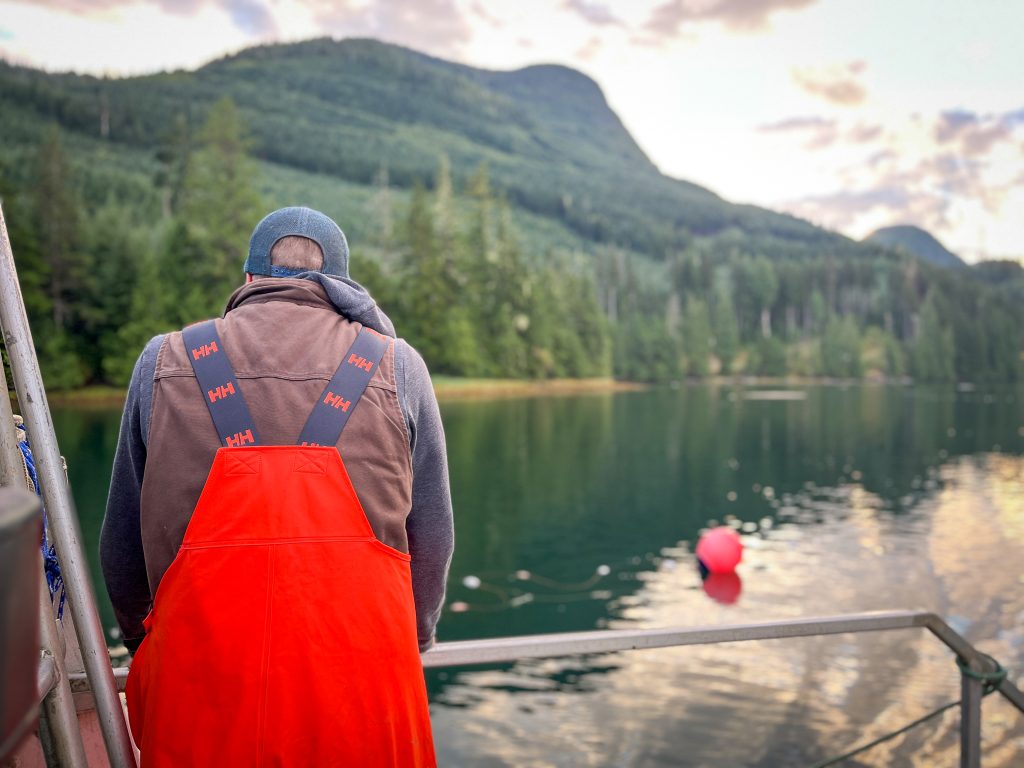
On Oct 21, 2026, Tasha Sutcliffe, Senior Policy Advisor for Ecotrust Canada, spoke to the Senate Committee on Fisheries and Oceans in Ottawa on the need for policy changes that support and rebuild British Columbia’s commercial fishery.
Below is the transcript.
Thank you for having me here today.
I am an independent contractor and am here in my role as Senior Policy Advisor with Ecotrust Canada. I also work with BC First Nations supporting the development of their community-based fisheries, a key aspect of fisheries reconciliation.
I have spent three decades working with fish harvesters and fishing communities. There are many challenges facing fisheries in BC, but one of the core issues limiting the sector’s full potential contribution to rural coastal economies and Canada is who beneficially owns and controls access to the resource.
I know you have heard from many on this issue. I’ll spend a minute speaking to the evidence of the impact that Pacific Region licence policy has had on fish harvesters, First Nations and coastal communities in BC.
Over the past 20 years, Ecotrust Canada, along with partner organizations, has researched socio-economic and demographic trends as well as general performance indicators of the fishery. We have seen many concerning themes, including the dramatic escalation of licence and quota prices (in many cases doubling over the last eight years), the rise of leasing as a practice as well as a rise in lease rates (as high as 50-80% of landed value), loss of independence of the fleet (in most home ports you’d be hard-pressed to find a full owner-operator left), significant drop in fishing jobs (40-50% over the last 20 years), and drop in fisher incomes (some of the lowest in the country). This is not a story of successful rationalization where we have lost local jobs, and those harvesters left are making a better living.
We have looked at the business structure of vessel enterprises in BC and modelled the enterprise viability of owner-operators versus lessees in a number of fisheries, and the numbers clearly show that vessel operators who lease are in a very vulnerable position. Their crew shares and boat shares are much lower than owner-operators, and as a result they are often not able to attract and retain skilled crew. They are not able to invest in the vessel maintenance required, and they have no job security or security of ongoing access to the fishery, and as a result they can not invest in their enterprise. We know licence prices have been grossly inflated and are well beyond the reach of fish harvesters, in some cases double what a harvester could reasonably afford.
I’d like to outline a business statement of a vessel enterprise, and we can see if it sounds like a viable business model:
At a 58% lease rate, it costs a halibut fisherman $217,500 to lease 30,000 lbs of halibut. Why are they leasing? It would cost them $3,750,000 to buy it. There is no option but to lease.
They then catch fish worth $375,000 in landed value, of which they only retain $157,500 after lease costs. They then have to pay all their fixed and operating costs, which leaves $26,805 for each crew member and $15,051 for the boat. So, in summary, on an amount of quota that would cost $3.7 million to buy, the crew each make $26,805, the boat share makes $15,000, and the lessor (not on the boat) makes $217,500.
Imagine a bad season. Let’s say the price drops 20% and the engine goes, not unlikely, as maintenance has been hard to keep up, and as a result, with lost revenue and an engine replacement cost of approximately 130k – that crew now makes about $11,800, and the skipper is now in the hole $125,000. In other words, the vessel is likely out of the fishery. Does not sound like a good economic model or one that we would expect to attract people.
We also know there is foreign ownership, and we know there is corporate concentration. As I have testified to before in 2023, it has only advanced since then:
- Large companies are continuing to buy up smaller local buyer operations to consolidate control of supply.
- Further vertical integration of supply chains and organized control of markets – with no transparency – placing fish harvesters in the position of being price takers and pushing out local community shore businesses.
- And an environment for fierce competition in the licence and quota market incentivizes upward pressure on pricing.
We’ve seen evidence of this in the loss of the added benefits that come from people spending their business earnings in their communities. Every dollar lost to a local harvester or shoreworker is a dollar they no longer have to spend locally, or on ancillary services, and a lost opportunity to expand on the landed value up the value chain. When we enable economic leakage from the pockets of the labour force, we are taking dollars out of our communities.
I want to touch on the issue of the lack of ownership transparency because I think it is key. We get told that there is not enough evidence on the issues of ownership. Why? Because no one, including DFO, knows.
Right now, you could go on the Pacific Region commercial licence listing site, look up who “holds” a prawn licence, and it would tell you a vessel and a name. But what it won’t tell you is if that holder owns the licence, or if they have a Trust Agreement with another entity that beneficially owns that licence. And nowhere is that tracked. It is a black box.
So, we have a resource which we work hard to protect and sustain, a resource that is renewable and a key part of our food security, and one that can provide local jobs in rural coastal areas facing economic struggles, and yet we have no ability to see who is buying and controlling access to it. And that means we also do not know who is getting the benefit. But we do know that there is economic loss, and it is the fish harvesters, First Nations and coastal communities bearing that loss.
For Atlantic Canada, we have regulations in place now to protect against this and a stated policy objective to ensure the benefits of the fishery stay local, but in BC none of that applies.
In my final comments, I want to address what can be done, and why I believe we have the tools to fix this; we just need the political will and focused effort of policymakers to do it.
First, we need the Minister to set and commit to policy direction with a clear time-bound transition plan that includes:
- Collecting the data needed to make informed decisions, including a registry of beneficial ownership.
- A lending program to enable harvesters’ access to the capital needed to invest in the fishery – akin to Farm Credit Canada.
- An immediate freeze on sales to any party other than an active harvester or First Nation.
- A defined multi-year period to fairly transition to fleet separation and owner-operator, during which the use of licence rules that will vary from fishery to fishery can be designed to ensure the fishery works as needed, e.g. leasing rules in groundfish. And to be clear, there may be exceptions such as the trawl fleet, which operates more like the offshore fishery.
I am happy to provide a bit more detail on this in question period or in a follow-up report.
In conclusion, fisheries policy and regulation must ensure that fish caught benefit those who are on the deck of the boat and their communities. It must support First Nations’ reconciliation objectives in fisheries and support a strong and resilient Canada.