

Executive Summary.
British Columbia is in a period of rapidly rising electricity demand. Without effective action, this growth will place greater pressure on the electricity system and contribute to higher energy costs for customers.
Load management technologies such as smart thermostats, batteries, and load controllers manage when and how households consume electricity, benefiting utilities through greater grid stability and lower system costs. They can also help households reduce electricity bills, avoid costly service upgrades, and unlock electrification benefits of improved health, safety, affordability, and comfort.
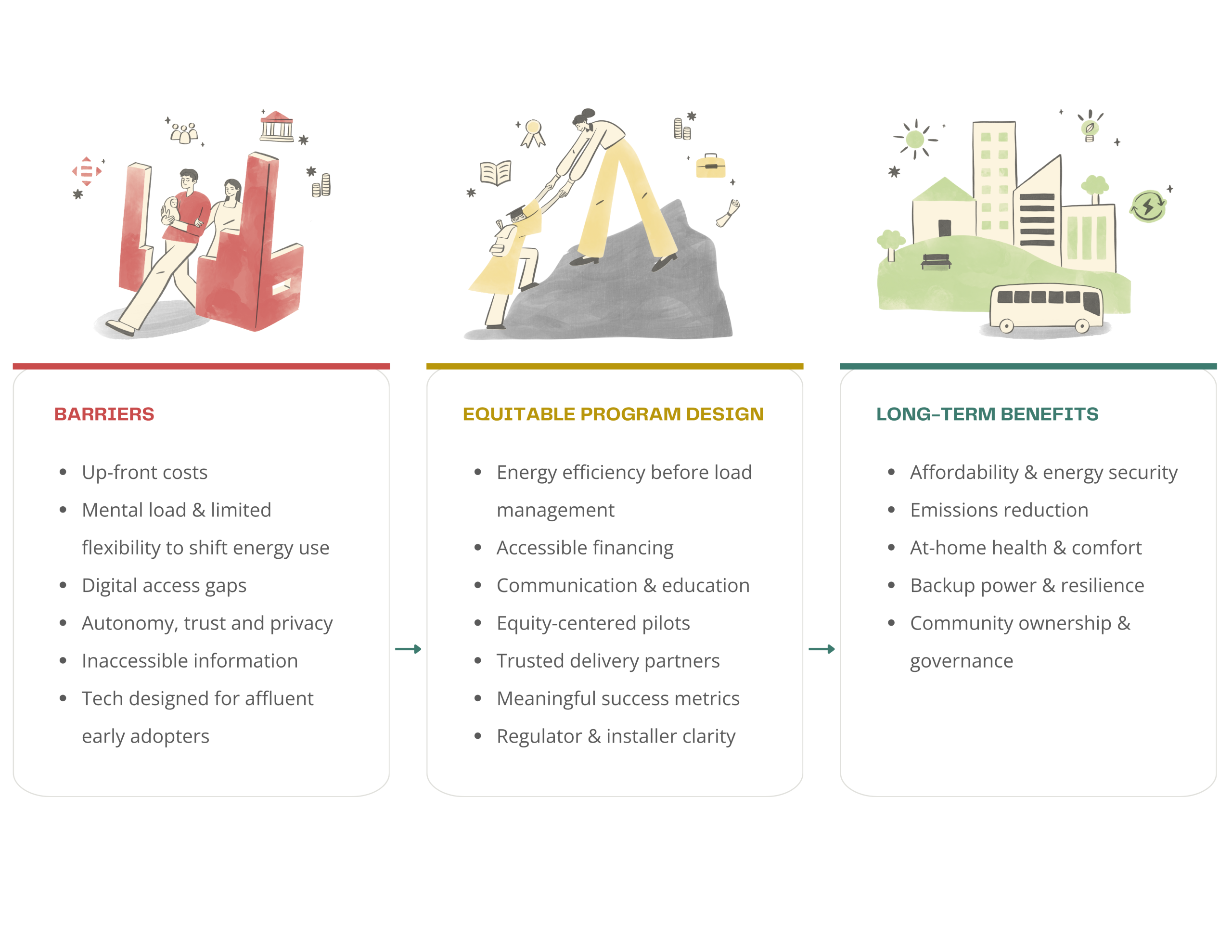
However, these shared benefits of load management will not be maximized or distributed equitably through technology deployment alone. The demand reduction potential of load management cannot be fully realized unless home retrofit programs and electricity rates account for the unique needs and circumstances of energy-insecure households. Achieving peak-demand reduction that also supports energy security across all households requires programs and rates that:
- Remove upfront cost and participation barriers,
- Protect households from higher bills, loss of comfort, and health or safety risks,
- Minimize the time and mental load required to participate, and
- Accommodate unique housing contexts and preferences.
The following load management solutions matrix was scored across equity and implementation considerations using evidence from stakeholder interviews, a literature review, and a household-level cost-benefit where data was available.
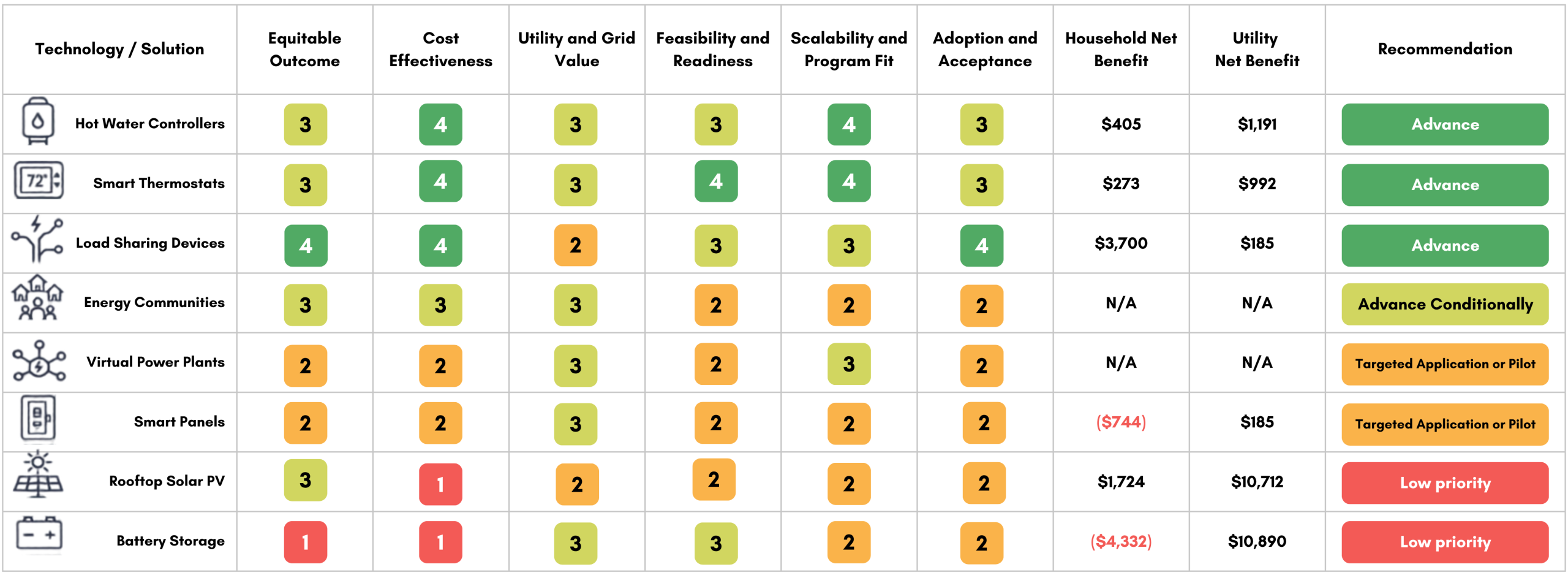
Three categories of actions are recommended. Solutions were prioritized where they can be implemented through existing programs and where they exhibit strong evidence of equity benefits. The recommended rate revisions complement BC Hydro’s current rate structure and adapt it to expand load management benefits to a wider population.
1. Advance the most promising load management technologies via BC Hydro’s Peak Saver program and Energy Conservation Assistance Program
(ECAP), and CleanBC’s Energy Savings Program.
- Offer free purchase and installation of smart thermostats and water heater load controllers via Peak Saver and raise rewards to reflect peak load reduction value.
- Make load sharing devices eligible for ESP retrofits where a service upgrade is unavailable, impractical, or exceeds the amount covered through the program.
- Provide training for ESP-approved contractors (through the Home Performance Stakeholder Council)
and ECAP advisors and contractors
on the application of load management technologies in participating households. - Incorporate Peak Saver education and enrollment support via ECAP and CleanBC’s Energy Coach Service so households can make an informed enrollment decision.
2. Expand access to shared solar generation to extend the benefits of larger-scale load management beyond individual homeowners.
- Increase the Community Generation rate for income-qualified customers or provide credits so lower-income ratepayers can benefit from solar generation.
- Reserve community-generation funding carve-outs for lower-income members, Indigenous communities, and housing cooperatives.
- Fund technical assistance and capacity building for community-led solar projects.
3. Design rates to align incentives for load management while protecting affordability.
- Amend the current Time-of-Use rate to add broader discounted shoulder periods.
- Offer bill protections for income-qualified Time-of-Use ratepayers, including first-year bill guarantees and penalty-free opt-outs.
- Provide personalized bill estimates so customers can easily compare rate options.
- Introduce a Subscription+ rate option with income-qualified supports.
Once short-term priorities are addressed, longer-term pilots and program amendments are also recommended. Actions include piloting plug-and-play batteries for renters, deploying battery storage in social and affordable housing, and restoring low-cost solar financing.
These recommendations will not be successful without the use of equity-focused program design. Applying program design best practices, including the use of trusted delivery partners and stakeholder-centered outreach, will help overcome participation barriers and reduce risk of harm. This design approach encourages broader participation, which not only enables long-term benefits to marginalized households but also creates a larger and more reliable source of peak-demand reduction for the electricity system.
Read the Full Report.
Equitable Load Management – Summary Slide Deck
Introduction.
British Columbia is experiencing significant electricity demand growth, and demand is expected to rise by approximately 50% over the next 15 years. This growth is being driven by rising industrial demand, through artificial intelligence and industrial electrification, and residential demand, via electric vehicle adoption and home electrification.
Electrification provides important economic, health, and environmental benefits, particularly for energy insecure households. Clean Energy Canada (CEC) estimates that households switching to a heat pump enjoy energy bill savings of up to $849 CAD per year and can reduce heating and cooling emissions by up to 97%. Enabling home electrification can have important health and safety benefits such as in-home air quality improvements and safer indoor temperatures. These issues are becoming more pressing given the risks of extreme heat. The 2021 heat dome was associated with over 600 heat-related deaths across the province. On a climate scale, province-wide electrification of space and water heating could reduce emissions by as much as 3.5 megatons per year, or about 6% of B.C.’s current emissions.ii British Columbia recognizes these broad benefits, setting a target of 100% clean electricity by 2030 through its CleanBC Roadmap.
However, electrification increases pressure on the grid by adding new electricity demand. Natural Resources Canada estimates that the number of heat pumps in B.C. homes nearly tripled from 2017 to 2022. While replacing fossil-fuel heating with electric heat pumps reduces emissions and lowers energy bills, widespread adoption also contributes to winter peak demand, which is projected to rise by 44% by 2050.
Because the system must serve the highest-demand hours, rising energy peaks on the coldest winter day require costly infrastructure investments that place upward pressure on electricity bills, disproportionately impacting energy-insecure households. Approximately 5% of B.C. households already spend at least 10% of their after-tax income on home energy, and rising bills mean more homes may have to choose between heating their home or buying groceries.
Residential demand response and load management are strategies for relieving peak electricity demand. These strategies create significant benefits for both utilities and households by shifting, limiting, or temporarily reducing flexible loads. Technologies such as water-heater controllers can pre-heat before peak periods, while batteries can charge overnight and provide electricity when demand is high. Load-sharing devices and smart panels can help households add electric appliances without exceeding their existing electrical capacity, avoiding costly service upgrades.
Electricity rates and utility-run demand-response programs can incentivize adoption of these technologies by rewarding households for shifting or reducing demand. BC Hydro is already incorporating load management into its energy planning through its Power Smart 2.0 plan. Released in May 2026, the program includes residential measures such as free smart thermostats and advancement of its Peak Saver program, a voluntary program that rewards customers for using less electricity during peak demand periods and allows the utility to make small, temporary adjustments to home devices. Coordinating many small reductions during peak periods can free system capacity, support grid reliability, and reduce the need for costly infrastructure upgrades. Research has shown that these programs not only benefit program participants, but they also drive down bills for all customers by reducing the total cost of operating the electric grid.
For more detailed background explanations on the topics of demand response, load management, and rate design and BC Hydro’s current programs, refer to Appendix I.
Electrification, load management, and B.C.’s energy inequity
Load management technologies, rate designs, and associated demand response programs can support more affordable electrification, but without deliberate program design, their benefits will not be distributed equitably and, in some cases, may even worsen energy insecurity.x Up-front costs, limited digital access, lack of control over housing infrastructure decisions, inflexible schedules, and concerns about utility control can exclude households that stand to benefit most. Research from the National Laboratory of the Rockies, formerly the National Renewable Energy Laboratory (NREL), emphasizes that early engagement and consideration of energy justice principles in program design are necessary to incorporate stakeholder needs and ensure that injustices are not “locked in” to the project development process.
These considerations are timely given the recent $222 million expansion of the Energy Conservation Assistance Program (ECAP), a province-wide program that provides no-cost energy efficiency improvements to income-qualified households. The expansion provides an opportunity to increase participation in residential load management while accounting for the unique contexts of energy insecure and marginalized households. xxv
To meet BC Hydro’s mandate to manage a safe, reliable, and affordable electricity system while supporting the public interest of British Columbia, the utility needs to understand the unique needs, benefits, and routines of households across the province. As electrification accelerates, the value of load management will increasingly depend on where technologies are deployed and which local grid constraints they help address. As Evan Pivnick of Clean Energy Canada explained, there can be “incredibly high value at a distribution level [to defer] infrastructure upgrades, but also to build out resiliency, support affordability, and enable electrification.” Analysis must also look beyond the broad category of “low-income households”, since renters, rural residents, Indigenous communities, seniors, medically vulnerable households, and other groups have distinct needs, constraints, and risks. Assessing load management across these contexts will help utilities and policymakers select appropriate technologies, design effective safeguards, and maximize benefits for households and the wider electricity system.
Finally, there is evidence that social acceptance of clean energy programs is more prevalent when distributive and procedural justice factors are recognized throughout project development. This suggests the critical importance of considering equity factors unique to British Columbia’s context if the province wants to meet its aggressive clean energy goals it has set out.
Read the Full Report.