
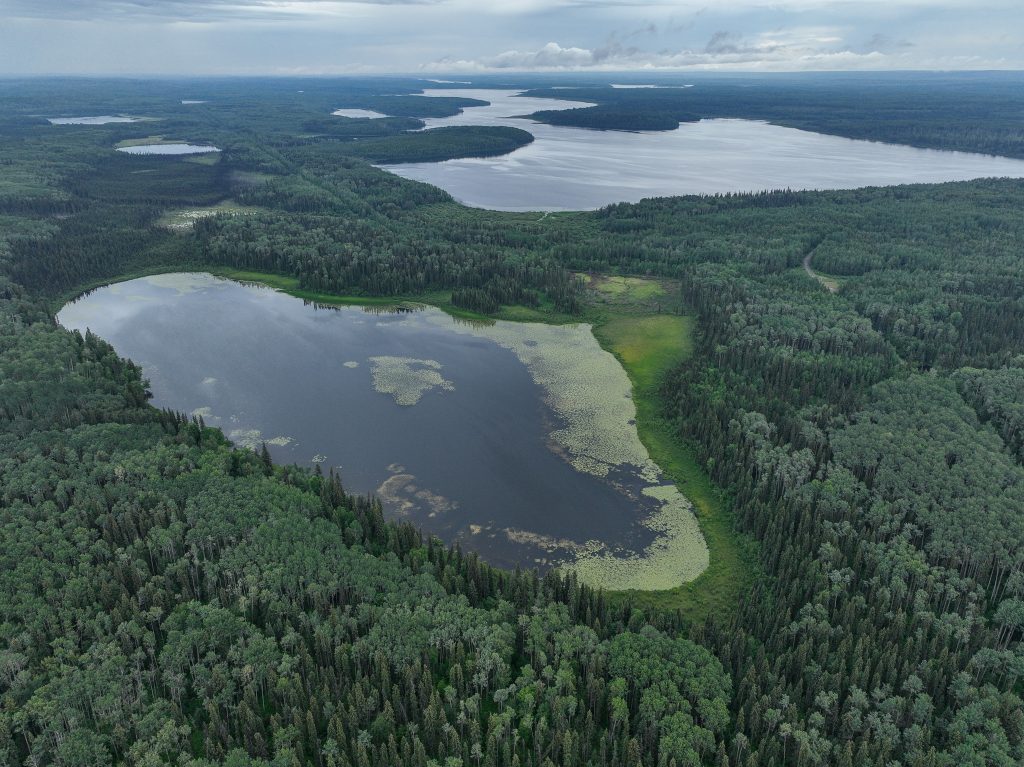
Michelle Connolly, Director of the Climate Resilience program, writes about the Maiyoo Keyoh, an Indigenous partner in central interior BC, and their role in caring for the land and building climate resilience. With permission from Jim Munroe, the President and CEO of the Maiyoo Keyoh Society, she weaves in conversations they’ve had over the years and more recently in March. The Maiyoo Keyoh* is part of our Climate Resilience Network.
Through this network, we collaborate with forest-dependent rural, remote, and Indigenous communities to identify economic alternatives to industrial logging and protect ancestral forests. These communities show that, with the right tools, capacity, and authority, their homelands can be resilient to climate change while meeting conservation, cultural, and socio-economic goals.

I moved to the central interior of BC fifteen years ago to continue my education and to settle down. During this time, I spent countless hours in the forests of my new home. As a nature enthusiast, I immersed myself in appreciating the lands and waters; the tall interior spruce trees, juicy black huckleberries, and salmon habitat. Yet, as I focused on getting to know the land, I overlooked the long-established system of land stewardship that has existed for millennia.
The Dakelh are the largest Indigenous cultural group in the central interior. Their ancestral lands are organized into keyohs, areas managed by extended family groups. Everyone in this region, myself included, lives within a keyoh.
A mutual friend introduced me to Jim Munroe a few years ago. Jim speaks on behalf of the Maiyoo Keyoh near Fort St. James. When we first met, he explained their stewardship system. Under the traditional land tenure system, legal authority and decision-making rest with the keyohwhuduchun, the hereditary head of a keyoh.
“They are entrusted with the care of ancestral lands and waters, and the well-being of the family who belongs to it,” he said.
Belonging to a place runs counter to the Western land management paradigm. In the Western system, lands and waters are called “resources,” seen as assets or possessions to be used. That word always bothered me. It was a relief to speak with someone like Jim who refused to use the word “resources” when talking about nature. For keyoh members, the towering forests, industrious beavers, and ambling rivers that characterize this rolling landscape, are much more than property.

My visits to the keyoh have brought these worldview differences into sharp focus. Last spring, during a visit to a village site, the skies opened, and a torrential downpour drenched us. We ran back to the truck to get dry. As Jim and I drove along the logging roads that criss-cross the Maiyoo Keyoh, observing cutblocks and the aftermath of the Great Beaver Lake fire of 2023, Jim recounted how his family established blockades over the last two decades to halt further industrial logging.

As he explained, “Industrial activity threatens the ecology of the land, and we want to prevent more of it from altering fish habitat, and the places ungulates like deer and moose spend the winter – our ancestral forests.”
Ancestral forests are self-managed, growing and adapting over time through natural events such as fires and beetle outbreaks, which enhance their complexity and value to wildlife. In contrast, Western land management systems control forests and harvest them for faraway economies that are indifferent to local needs. For keyoh-holders, this is antithetical to their traditional worldview.
Before the arrival of colonial boundaries and resource industries, the lands and waters of the keyohs supported a sustainable way of life in the central interior, providing food, medicine, shelter materials, and spiritual connection.
My understanding of this relationship deepened while watching two blue-winged teals fly over Tsa Tizli (Beaver Creek). Witnessing this, I experienced firsthand the value of supporting the enduring relationship between people and land – ties that have survived millennia and continue today as communities strive to protect and restore a vital ecosystem for generations to come.

Despite decades of resource extraction, Jim remains clear-eyed about the path forward. During a visit in March 2026, he explained, “the transition back to fully sustainable livelihoods in balance with a protected ancestral forest and rewilded plantation will take a long time, but that is the Maiyoo Keyoh’s unwavering objective.”
Looking ahead, Maiyoo Keyoh’s cultural resilience and traditional land management system will be the foundation for climate resilience. By caring for their lands and waters, they safeguard their adaptive capacity to face future climatic challenges. Ecotrust Canada remains committed to supporting Maiyoo Keyoh, as they protect their remaining ancestral forests and revive the living wealth of the logged ones.
Learn more about the Climate Resilience Network.
*Pronunciations
Dakelh (pronounced DA-kelh)
Maiyoo Keyoh (pronounced MY-you KAY-yo)