
 [Published April 30, 2026]
It’s that time of year again. Gardeners everywhere are poring through seed catalogues, trying to decide what to grow. Many are asking themselves questions like: What are my goals for the garden this year? Which plants will help me achieve those goals? The Food Systems team at Ecotrust Canada is no different. In this blog, we share our thought process in choosing a roster of plants for our second year of the North Coast Food Hub, a community-driven initiative building greenhouses, kitchens, and markets to grow food security, economic opportunity, and resilience on BC’s North Coast.
Gardening Goals
On the North Coast, gardens tend to have limited space, as most growers use raised beds to facilitate drainage. Each plant needs to meaningfully contribute to the gardener’s goals to earn a spot in the bed. For example, goals could include providing home-grown calories, adding healthy micronutrients, or saving money on groceries. For each of these examples, a different roster of plants will be optimal.
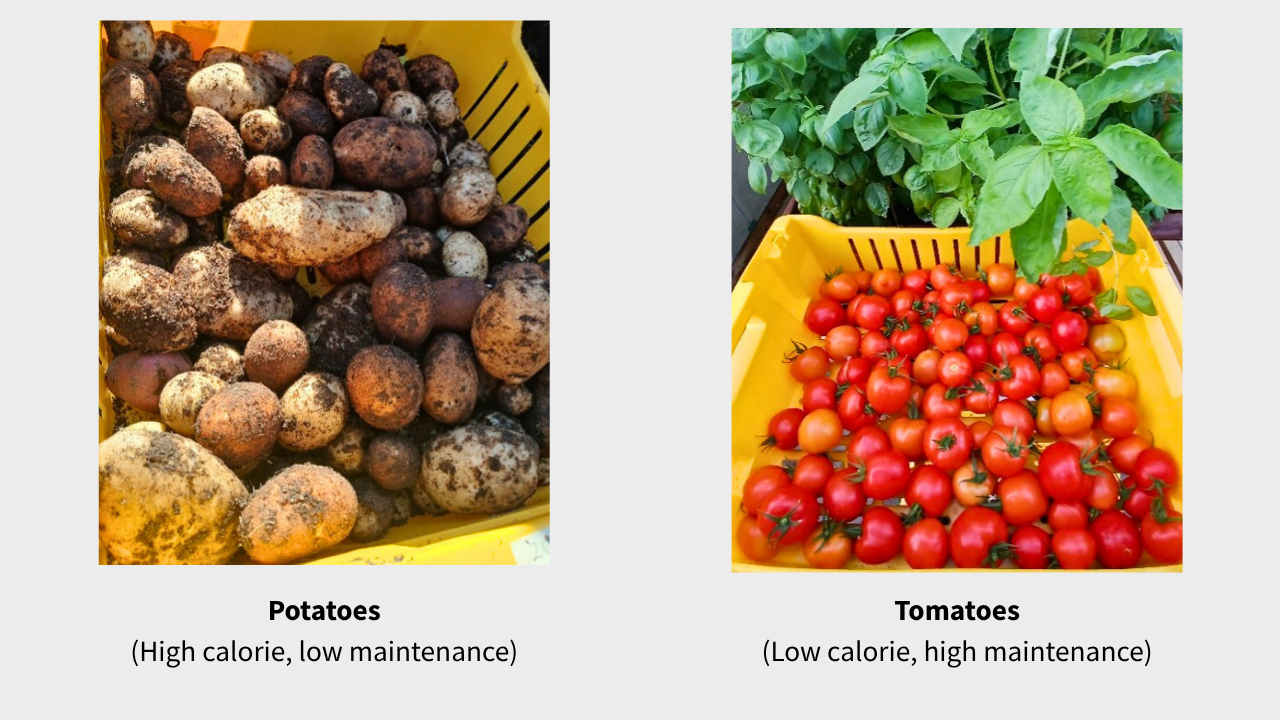
To illustrate, suppose a gardener wants to grow a large proportion of their food at home with minimal effort. This grower would be most interested in plants that produce large amounts of calories and macronutrients (carbohydrates, proteins, and fats), while requiring little effort to grow. A potato plant does this well, while a tomato does not. Apart from hilling once or twice per season, potatoes are low maintenance and produce lots of calories per square meter of bed space. On the other side of the spectrum, tomatoes require pruning, careful watering, and a greenhouse environment to grow well on the North Coast. While delicious, tomatoes are not high in calories, making potatoes a better choice if your goal is to produce a staple crop.
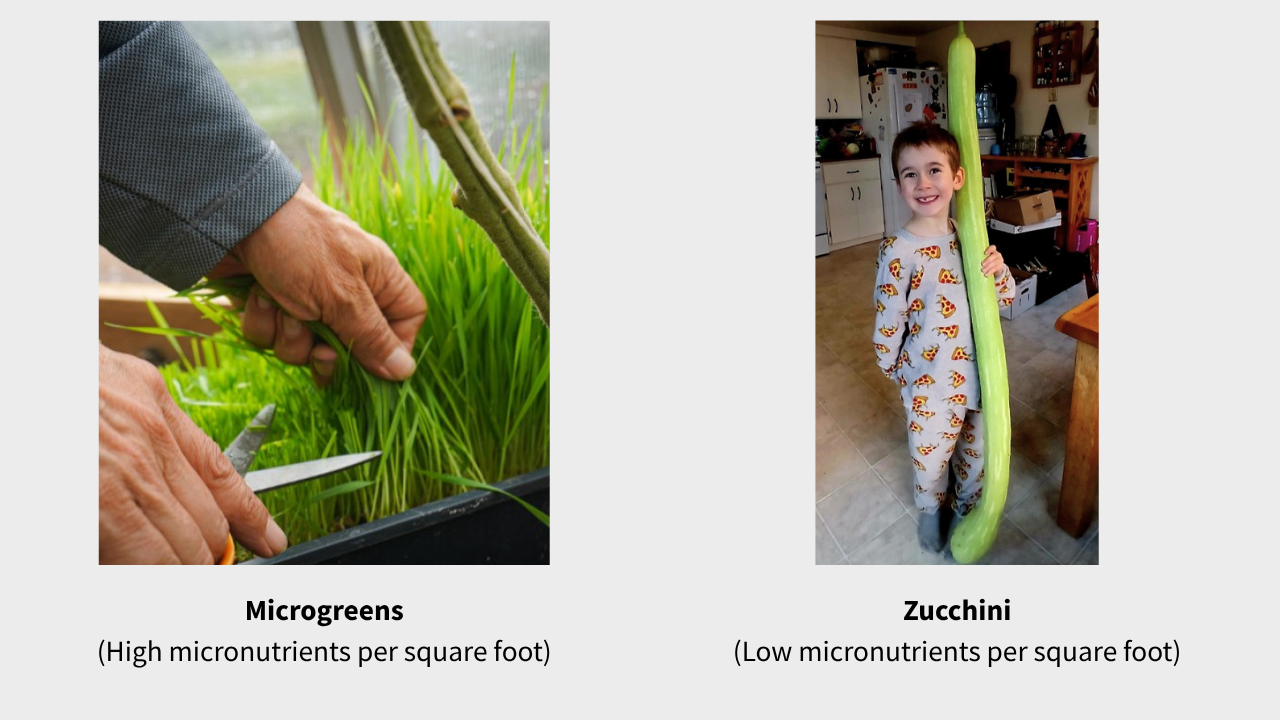
Other gardeners may be more interested in realizing nutritional benefits in a limited growing area. For these gardeners, maximizing micronutrients per square meter is key. Microgreens are a great way to achieve this, while squash generally scores low on this metric.
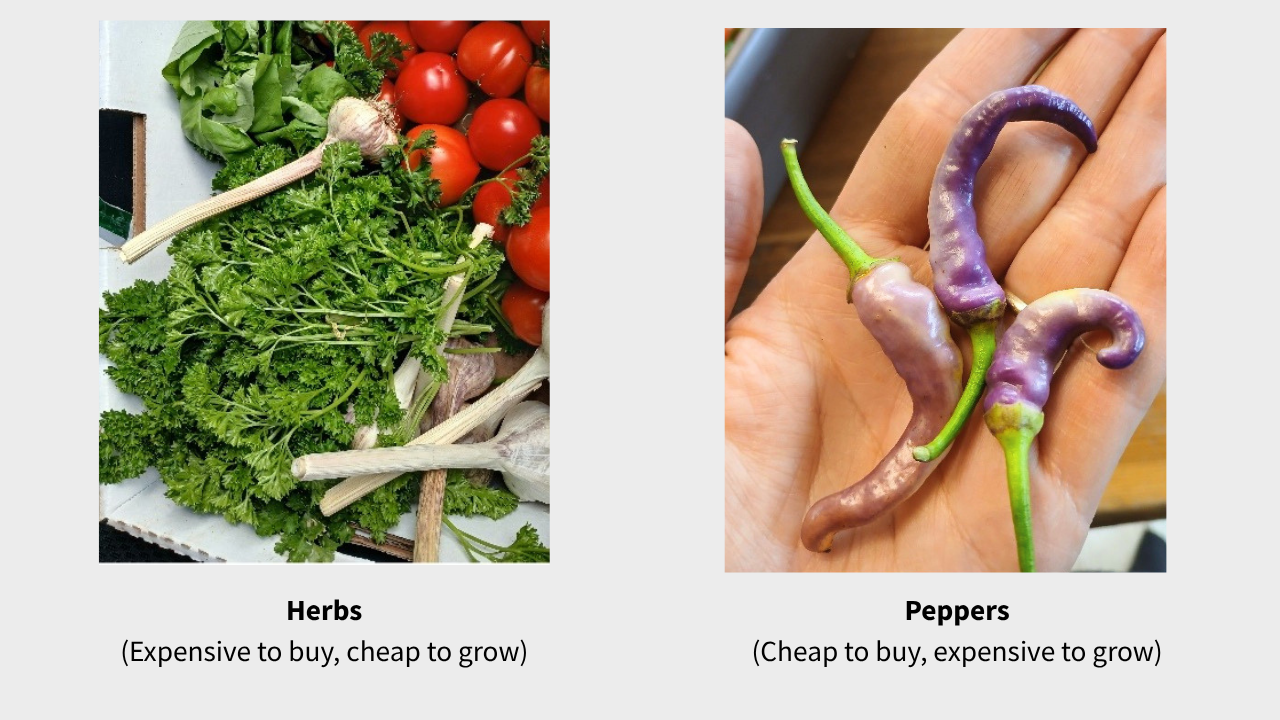
As a final example, consider a gardener aiming to reduce their grocery bills. For them, the ideal plant replaces an expensive grocery store item while being cheap to grow at home. Herbs are a category of plants that excel by this metric. They are easy to grow in a home garden, and they are expensive to buy at the grocery store. Conversely, peppers are relatively expensive to grow and cheap to buy.
Of course, this is not an exhaustive list of factors influencing the choice of plants. Large commercial farms tend to take a numbers-based approach to maximize their return on investment. Home gardeners may be growing for more personal reasons like aesthetics, discovery, or nostalgia. I always grow a few tomatoes at home, even though they struggle in my climate, because they are a familiar food from my childhood. The North Coast Food Hub gardens are somewhere in between. We want to use our resources as efficiently as possible to achieve our goals, but we have factors to consider beyond just profit.
Our Approach
The greenhouses of the North Coast Food Hub have three main goals:
- Provide nutritious food for the school food programs in Prince Rupert.
- Create hands-on educational opportunities for Prince Rupert students.
- Generate revenue that can be used to cover our operating costs.
In 2026, we are growing tomatoes, carrots, peas, beans, cucumbers, summer squash, herbs, potatoes, garlic and more for the school food programs. The nutrients/square foot metric is valuable here, but we have other factors to consider. The school staff have requested lots of raw vegetable finger foods because they have a local hydroponic greenhouse supplying their leafy greens. We will be growing shiso (an herb) and other greens not currently produced locally, as well as some niche items, like mushrooms, a source of vitamin D.
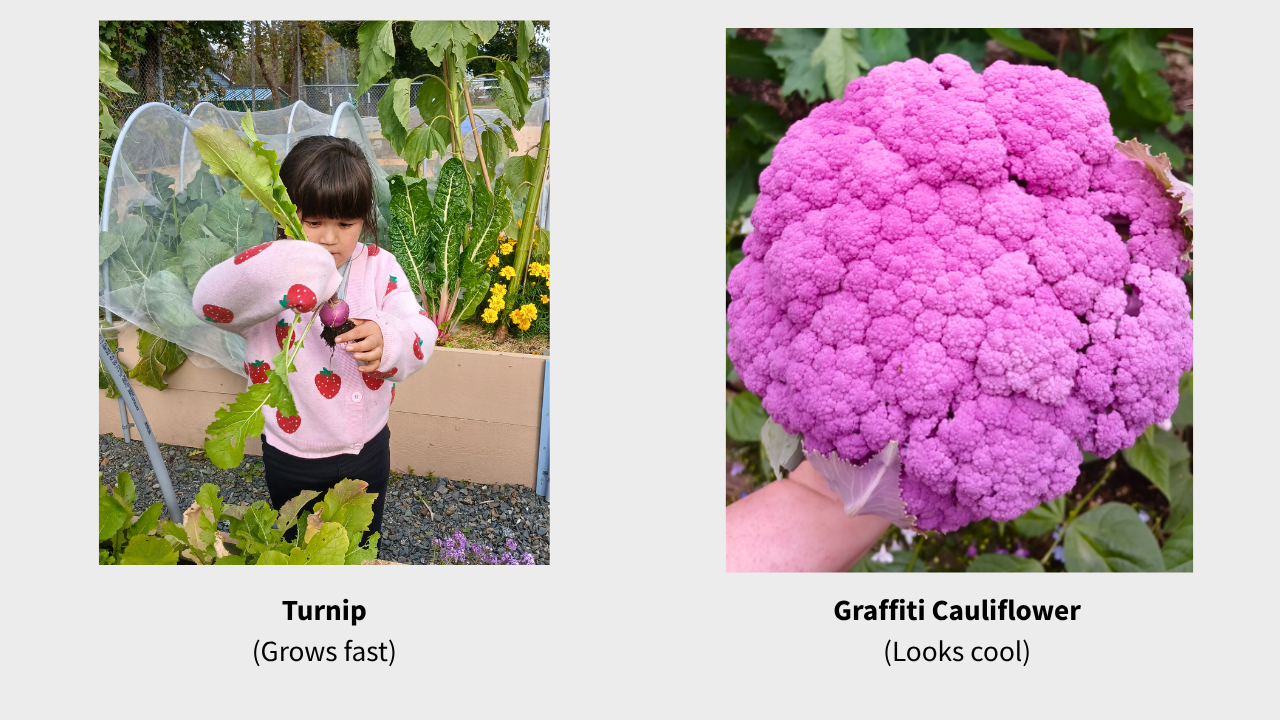
Some of our greenhouse plants are chosen specifically for our education programs. These include fast-growing plants like radishes and turnips, which allow students to see the whole life cycle. We also choose funky plant colours to keep students interested, like the graffiti cauliflower shown below.
In the future, our goal is to make the greenhouse financially self-sustaining by selling produce into the community to cover the costs of operating the greenhouses. Plant choices to support this goal will include herbs and garlic, because they are relatively cheap to grow but fetch a high price. We will also seek out specialty plants that restaurants are willing to pay a premium for because they are not available locally.
Our Favourite Varieties for the North Coast
Chelsey Wingfield, our Greenhouse Coordinator, has hand-picked our plant varieties, drawing on over 20 years of gardening experience in Prince Rupert. We are sharing some of our favourites here. Keep in mind that we are growing these in Prince Rupert, BC, some outdoors and some in a greenhouse.
Ecotrust Canada will be growing both potatoes and tomatoes in our gardens this year. Early Girl, Sakura, Tasti Lee, Sweet Heart Grape, Moskovich, Prairie Fire, and Tumbling Tom are some of our favourite tomato varieties to grow on the North Coast, chosen for their cold tolerance, blight and fungus resistance, flavour and productivity. We grow them in a greenhouse to provide the heat they need. We will be growing Pacific Russet and Ozette (Haida) potatoes, along with other more colourful varieties for fun in outdoor beds at the schools.
Ecotrust Canada is planning to grow both squash and microgreens this year. On the squash side, our focus will be on zucchini, with Goldy, Black Beauty and Trombone (tromboncino) being our favourites. This year, we’re mostly skipping winter squash. We don’t have enough room to dedicate to these large plants for their relatively small output. We will likely plant a few spaghetti squash or mini pumpkins to show that it is possible to grow them in Prince Rupert, plus it’s fun for the students. We will be looking into microgreens in the fall, when the main garden slows down, and we may do a taste test to find milder varieties that appeal to the students.
Our garden will grow all the herbs we can, and a few peppers for variety and student interest. Basil, rosemary, parsley, thyme, sage, chives, mints, lemon balm, green bunching onions, and cilantro have already started, and more will be planted as the weather warms up. These herbs can be dried or preserved in other ways for year-round use. For peppers, we choose varieties with a short growing season, such as jalapeno, shishito, and Thai chilli. These do better in our climate than full-size bell peppers. The purple peppers in the picture above are descended from filius blue pepper. Chelsey has been saving seeds for these cute spicy peppers year after year. These peppers produce well while staying compact, ideal for our raised beds and classroom containers.
Looking forward
As winter gives way to spring, plant variety decisions are locked in, and the gardener settles into the rhythm of watering, weeding, and observing. In this second year of the North Coast Food Hub, the team at Ecotrust Canada will strive to make the most of improved infrastructure to increase access to healthy, locally grown food for students and their families. We look forward to sharing what we learn and what we grow with the communities we serve.
For more information on the North Coast Food Hub, reach out to Dianne.